
Key Takeaways
- IEEE 2030.5 is now mandatory for all new DER installations under California Rule 21
- PKI infrastructure with X.509 certificates is required for device authentication
- Existing fleets must migrate starting Q3 2026 with full compliance expected by 2027
- DERSync simplifies compliance with automated PKI, protocol translation, and continuous monitoring
The Regulatory Landscape Is Shifting
IEEE 2030.5 (Smart Energy Profile 2.0) has moved from optional standard to regulatory requirement. California Rule 21, the model for DER interconnection standards nationwide, now mandates IEEE 2030.5 as the default communication protocol for all new DER installations.
For DER operators, this creates both opportunity and obligation. IEEE 2030.5 enables sophisticated grid participation — demand response, frequency regulation, voltage support. But it also introduces security requirements that many operators are unprepared to meet.
New CA Installations
Required Encryption
Full Compliance Deadline
Key Compliance Requirements
PKI and Certificate Management
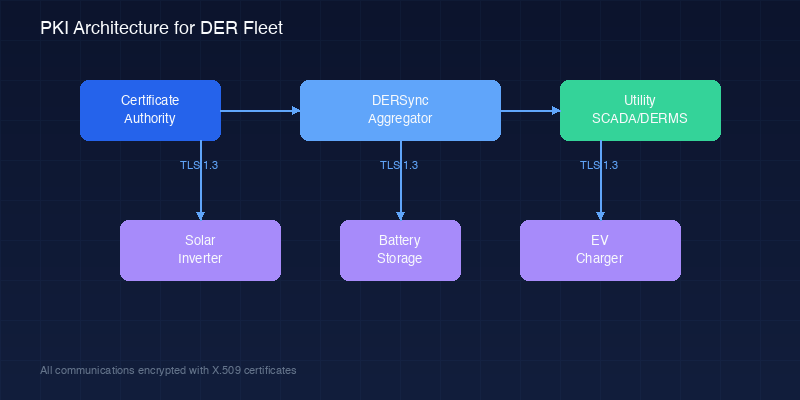
IEEE 2030.5 requires Public Key Infrastructure (PKI) for device authentication. Every DER device must have a valid X.509 certificate issued by a trusted Certificate Authority. This means:
- Automated certificate provisioning for fleet-scale deployments
- Certificate lifecycle management — issuance, renewal, revocation
- TLS 1.3 encryption for all device-to-aggregator communications
- Hardware security modules (HSM) for key protection in production environments
Protocol Conformance
Devices must implement the IEEE 2030.5 protocol stack correctly — not just the communication layer, but the semantic behavior defined in the specification. This includes correct handling of:
- DER capability reporting and nameplate data
- Default DER Control (autonomous functions)
- DER program participation (demand response, VPP)
- Monitoring and telemetry reporting intervals
Security Posture
Beyond PKI, operators must demonstrate ongoing security monitoring and incident response capabilities for their DER fleet. This is where many organizations face the biggest challenge — traditional IT security tools do not understand DER protocols.
Important
Compliance is not just about implementing the protocol correctly. It is about proving that your DER fleet is continuously monitored and that you can detect and respond to threats in real-time. Organizations that wait until enforcement deadlines risk costly retrofits and potential non-compliance penalties.
How DERSync Simplifies Compliance
DERSync provides the secure aggregation layer that IEEE 2030.5 compliance requires:
DERSync Compliance Features
Automated PKI — Zero-touch certificate provisioning and lifecycle management for fleets of any size. Protocol Translation — Convert SunSpec Modbus, DNP3, and proprietary protocols to IEEE 2030.5 without replacing existing hardware. Continuous Monitoring — Real-time telemetry verification and compliance validation with audit-ready reporting. Security Integration — Clean data feed to DERSec Sentry for cyber-physical verification.
Timeline and Action Items
If you operate DER assets in California or anticipate IEEE 2030.5 requirements in your jurisdiction, the time to prepare is now.
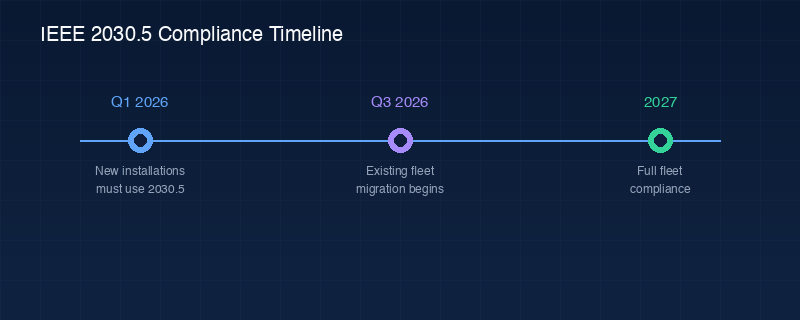
- Q1 2026 — All new Rule 21 installations must use IEEE 2030.5
- Q3 2026 — Existing installations begin migration timeline
- 2027 — Full fleet compliance expected for major utilities
Learn how DERSync can accelerate your IEEE 2030.5 compliance journey.